


Editorial Note
Veteran-Owned Business Spotlight is a recurring New To Education series highlighting businesses with publicly reported veteran founder, veteran ownership, military service, or veteran-led leadership stories. This article is intended for educational and informational purposes only. Inclusion in this series does not constitute an endorsement, sponsorship, paid promotion, certification claim, or recommendation of any company, product, or service. Business details may change over time, so readers should consult official company sources for the most current information.
Some businesses begin with a detailed plan, a polished pitch deck, and a clear path from idea to market. Others begin more naturally, almost by accident, when someone notices a need, follows curiosity, and keeps going.
Sticky Spoons Jam, LLC appears to be one of those businesses.
Based in Niles, Michigan, Sticky Spoons Jam is a small-batch jam and preserve company founded by U.S. Navy veteran Aiyenede “Aiye” Akhigbe. The company publicly describes itself as female veteran-owned, and several business profiles describe it as a Black woman veteran-owned business rooted in local Michigan fruit, small family farms, and bold flavor combinations.
That already gives the company a strong business story. But what makes Sticky Spoons especially interesting is how many themes come together in one jar: military service, food entrepreneurship, local agriculture, community support, small-business mentorship, and the courage to grow from a small idea into a larger operation.
Sticky Spoons Jam is not just a story about jam. It is a story about turning experience, taste, and community into a business.
The Story Behind Sticky Spoons Jam
Sticky Spoons Jam began with a simple food idea: create flavorful jams and preserves using locally sourced Michigan fruit. The company’s official website says it focuses on female veteran-owned jams and preserves, with fruits sourced from small family-owned farms in Southwest Michigan.
That local focus matters.
Food businesses often feel strongest when they are tied to place. Sticky Spoons is not trying to be a generic jam company with no identity. Its public materials emphasize Michigan fruit, neighboring farms, small businesses, and flavors that reflect local agricultural strength.
Michigan’s fruit industry gives the company a natural foundation. Berries, peaches, apples, and other fruits can become more than ingredients. They become part of a regional story.
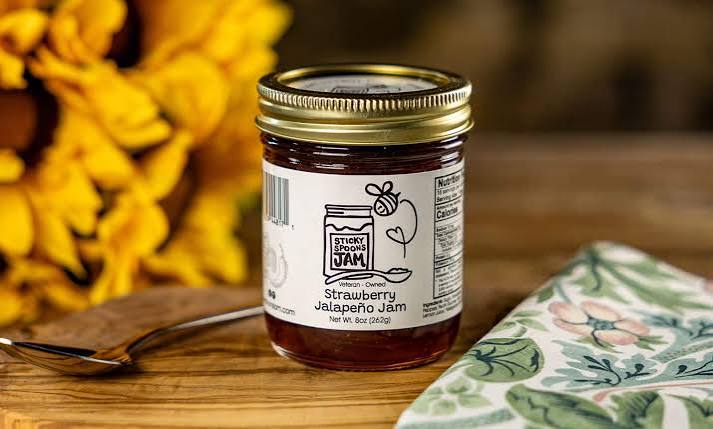
Sticky Spoons takes that story and turns it into products that are meant to feel both familiar and surprising. Flavors such as blueberry lavender, peach basil jalapeño, strawberry jalapeño, apple pie, and lunar eclipse show that the company is not only preserving fruit. It is experimenting with personality.
A Veteran Founder With an Unexpected Path
Aiye Akhigbe’s path into entrepreneurship was not something she always planned.
Michigan Business described her journey as moving from Navy veteran to small business owner in Southwest Michigan. In that profile, Akhigbe said she never originally wanted to be a business owner and that entrepreneurship was something she “fell into.”
That honesty makes the story relatable.
Many people assume entrepreneurs are born with a business plan in their hands. In reality, many founders discover entrepreneurship through life experience, necessity, curiosity, or a small opportunity that keeps growing.
Akhigbe’s military background adds another layer. Iona University reported that she served as a Third-Class Petty Officer, Engineman in the U.S. Navy and earned her Enlisted Surface Warfare Specialist Pin after six months aboard a warship. That kind of experience suggests discipline, adaptability, technical skill, and the ability to function under pressure.
Those qualities can matter in business. Food entrepreneurship requires consistency, problem-solving, compliance, customer service, production planning, and resilience. A jam company may sound sweet, but running one still takes grit.
From Cottage Food to Licensed Kitchen
One of the most educational parts of the Sticky Spoons Jam story is the company’s growth from small-scale production toward a licensed commercial kitchen.
Michigan State University Extension reported that Sticky Spoons Jam won the MSU Product Center’s 2024 Best Barrier Buster Award after building a commercial kitchen on the family property and securing a license from the Michigan Department of Agriculture and Rural Development. Before that expansion, the business operated under Michigan’s Cottage Food Law.
That matters because this is exactly the kind of growth step many food entrepreneurs face.
A cottage-food business can help someone test an idea, build a customer base, and learn whether there is demand. But scaling usually requires more. Food businesses may need licensing, inspections, labeling support, production space, financing, wholesale relationships, packaging decisions, and distribution planning.
Sticky Spoons’ move into a licensed kitchen shows how a small food idea can become a more serious business operation.
It also shows that entrepreneurship often happens in stages. You do not need to know everything on day one. But as the business grows, the founder has to keep learning.
Local Farms Are Part of the Brand
Sticky Spoons’ local sourcing is one of its strongest business features.
The company’s official website says it sources ingredients from neighboring farms and small businesses. Michigan Business reported that when Akhigbe makes jam blends, 50% of the fruit must be grown in Michigan, and the business works with small, family-owned farms in Southwest Michigan. Other profiles have described an even stronger local sourcing emphasis, including fruit from small family farms within a close radius of the company’s location.
That local farm connection gives Sticky Spoons more than a supply chain. It gives the company a community identity.
When a small business buys from nearby farms, the impact can ripple outward. Farmers gain another buyer. Customers gain a product tied to the region. The business gains authenticity. The local economy keeps more value close to home.
This is one reason food entrepreneurship can be so powerful. A jar of jam may look small, but behind it can be farmers, kitchens, markets, packaging suppliers, mentors, retailers, and families.
Flavor as a Business Strategy
Sticky Spoons Jam stands out because it does not rely only on traditional flavors.
The company is known for creative combinations designed to surprise customers. Public profiles mention flavors such as blueberry lavender, strawberry jalapeño, peach basil jalapeño, apple pie, lunar eclipse, and many others. Iona University reported that Akhigbe makes more than 100 flavors free from preservatives, artificial flavors, and high-fructose corn syrup.
That variety matters because food businesses often need a hook.
Strawberry jam is familiar. But strawberry jalapeño or blueberry lavender can make a customer pause, ask a question, taste a sample, and remember the brand. In crowded markets, flavor can become marketing.
Akhigbe’s own comments in the Iona University profile also show the emotional side of food entrepreneurship. She described enjoying when customers react strongly to samples and said that emotional response gives her room to be adventurous when creating flavors.
That is a useful business lesson. Customers do not only buy products. They buy experiences, memories, feelings, and stories.
Community Support and Giving Back
Sticky Spoons Jam also has a meaningful community angle.
The company’s official “About Us” page says Sticky Spoons is about crafting connections, nurturing communities, and celebrating Michigan’s spirit. Iona University reported that Akhigbe and her team support local programs while also collecting food, clothing, and toiletries for people experiencing homelessness.
That matters because a small business can be more than a place that sells products. It can become part of the community fabric.
For veteran-owned businesses especially, community can be a powerful theme. Military service often creates a sense of mission and responsibility. In civilian life, some veterans continue that sense of service through entrepreneurship, mentorship, employment, volunteering, or local support.
Sticky Spoons’ public story fits that pattern. The company is not only making jam. It is also building relationships.
Why Mentorship Matters
Another important lesson from Sticky Spoons is the value of business mentorship.
The company has been highlighted by organizations such as the Michigan SBDC, Michigan State University Extension, Michigan Women Forward, and other business-support networks. MSU Extension specifically described how the MSU Product Center helped support the company’s move from cottage-food production toward licensed food production.
This is important because many entrepreneurs do not fail because they lack passion. They struggle because they lack guidance.
A food business can involve labeling rules, product testing, shelf stability, licensing, packaging, financing, wholesale pricing, distribution, marketing, and inventory. Mentors and small-business support organizations can help founders avoid mistakes and make better decisions.
Sticky Spoons is a good example of why business education does not only happen in classrooms. Sometimes it happens through counseling, local networks, pitch competitions, product centers, and community organizations.
Why This Business Fits a New To Education Spotlight
Sticky Spoons Jam is a strong fit for New To Education because it touches several educational themes at once.
It is a veteran entrepreneurship story. It is a small-business growth story. It is a local agriculture story. It is a food production story. It is also a career-transition story.
Students and adult learners can learn from all of that.
A business like Sticky Spoons shows that entrepreneurship is not only about technology startups or large companies. A person can build a meaningful business around food, farming, taste, community, and local identity. That kind of business still requires strategy, creativity, financial decision-making, communication, and problem-solving.
It also shows students that career paths are not always straight. A Navy veteran can become a food entrepreneur. A small jam idea can grow into a licensed operation. A local product can become a wider brand.
That is real-world learning.
Lessons for Veteran Entrepreneurs
Sticky Spoons Jam offers several useful lessons for veteran entrepreneurs.
First, start with something real. Sticky Spoons is built around products people can taste, remember, and share. The company’s flavors create conversation, and conversation helps a small brand grow.
Second, use your local community. The business leans into Michigan fruit, small family farms, and regional identity. That gives the brand a story bigger than the product itself.
Third, seek support. Sticky Spoons’ growth shows the value of mentorship and small-business resources. Founders do not have to build everything alone.
Finally, let the mission show. Sticky Spoons connects food, community, and service in a way that feels natural. That helps the veteran-owned identity feel authentic rather than added on after the fact.
Lessons for Students and Families
Students can learn a lot from Sticky Spoons Jam.
The company shows that creativity and business can work together. A flavor idea becomes product development. A farmers market becomes customer research. A jar label becomes branding. A local farm partnership becomes supply-chain strategy. A storefront becomes community engagement.
That is entrepreneurship in real life.
Families can also use this story to talk with students about different career pathways. Success does not always mean following one traditional route. Some people build careers by combining past experience, local opportunity, creativity, and persistence.
Sticky Spoons is also a reminder that small businesses are not small in meaning. They create jobs, support farms, strengthen local economies, and give communities something to be proud of.
Why Veteran-Owned Businesses Matter
Veteran-owned businesses matter because they show what service can become after military life.
Veterans often leave the military with experience in leadership, teamwork, discipline, operations, logistics, and problem-solving. Those skills can transfer into entrepreneurship, but transition still takes courage. Starting a business means taking risks, learning new systems, and accepting uncertainty.
Akhigbe’s story reflects that kind of transition. Her Navy background is part of the story, but the business also stands on its own. Sticky Spoons is not simply a veteran-owned label. It is a growing food business with a local identity and a clear product vision.
That is what makes the spotlight meaningful.
It shows service, but it also shows skill.
Why This Story Matters for New To Education Readers
This story matters because New To Education focuses on learning, growth, and opportunity.
Sticky Spoons Jam is a reminder that education is not only about school subjects. It is also about learning how to build, adapt, serve, and create value. A small-business owner has to learn constantly. They learn from customers, mentors, farms, regulations, mistakes, markets, and the community.
For veterans, Sticky Spoons offers a positive example of post-service entrepreneurship. For students, it offers a practical example of creativity becoming business. For families, it shows how local products can carry deeper stories. For future entrepreneurs, it is a reminder that support systems matter.
A jar of jam may seem simple, but Sticky Spoons shows how much can be inside one small product: service, flavor, farming, community, and the courage to keep growing.
Key Takeaways
Sticky Spoons Jam, LLC is a small-batch jam and preserve company based in Niles, Michigan. The company publicly describes itself as female veteran-owned, and several business profiles describe it as a Black woman veteran-owned business founded by U.S. Navy veteran Aiyenede “Aiye” Akhigbe.
The company focuses on locally sourced Michigan fruit and creative flavors such as blueberry lavender, peach basil jalapeño, strawberry jalapeño, apple pie, and lunar eclipse.
Sticky Spoons’ growth from cottage-food production to a licensed commercial kitchen shows the real learning curve behind food entrepreneurship.
For New To Education readers, this business is a strong example of how veteran experience, local agriculture, creativity, mentorship, and community support can come together in a small-business story.
FAQ
What is Sticky Spoons Jam, LLC?
Sticky Spoons Jam, LLC is a small-batch jam and preserve company based in Niles, Michigan.
Who founded Sticky Spoons Jam?
Sticky Spoons Jam was founded by Aiyenede “Aiye” Akhigbe, a U.S. Navy veteran and entrepreneur.
Is Sticky Spoons Jam veteran-owned?
Yes. The company publicly describes itself as female veteran-owned, and multiple business profiles identify it as veteran-owned.
What makes Sticky Spoons Jam different?
The company focuses on creative small-batch flavors, locally sourced Michigan fruit, and preservative-free products without artificial flavors or high-fructose corn syrup.
Why is this a good New To Education business spotlight?
Sticky Spoons Jam connects veteran entrepreneurship, local farming, food production, creative branding, mentorship, community support, and small-business growth. That makes it a useful example for students, families, veterans, and future entrepreneurs.
Related Articles
10 Ways New To Education Can Help Your Business Grow
What You Can Do on New To Education
Sources
Sticky Spoons Jam — Official Website
Michigan Business — Aiye Akhigbe of Sticky Spoons Jam
Michigan State University Extension — Sticky Spoons Jam Wins 2024 Best Barrier Buster Award
Iona University — Aiyenede Akhigbe and Sticky Spoons Jam
Michigan Women Forward — Sticky Spoons Jam, LLC
Michigan SBDC — Sticky Spoons Jam
Visit Southwest Michigan — Sticky Spoons Jam
New To Education — 10 Ways New To Education Can Help Your Business Grow