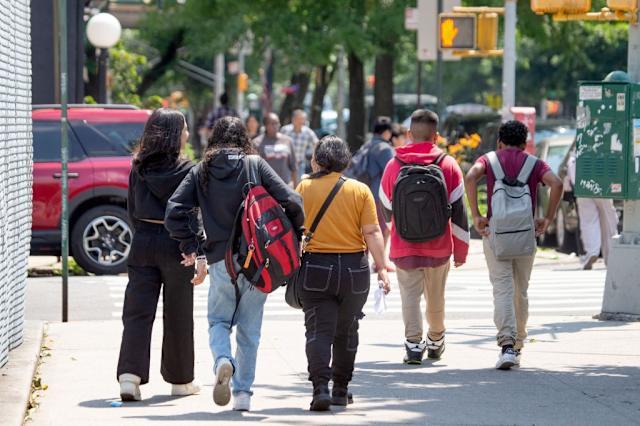

New York City’s long-running fight over class size entered a new phase in June 2026, when state leaders, City Hall, and the teachers’ union aligned on a delay that gives the school system more time to meet the state’s class-size mandate.
On paper, the change looks straightforward: the city now reportedly has until the 2029-30 school year to fully comply. In practice, it reshapes a major education promise into a slower, more politically complicated rollout, with new milestones, new labor costs, and fresh questions about whether the city can eventually deliver smaller classes at scale.
The development matters because New York City runs the nation’s largest school system. Any shift in how quickly it must lower class sizes affects staffing, school space, spending, and the day-to-day experience of students and teachers.
What changed
The original 2022 law required New York City to bring most classes down to capped levels over a phased-in timeline. Reported benchmarks under that original structure required 80% of classrooms to comply by the coming school year, with full compliance shortly after. The caps themselves have not changed: 20 students in grades K-3, 23 in grades 4-8, and 25 in high school. [1][2][3]
What changed in June 2026 is the timeline.
Current reporting says the city now has a revised path: 70% compliance in 2026-27, 80% in 2027-28, 90% in 2028-29, and full compliance in 2029-30. [1][2] That effectively pushes back the deadline by two years.
This is not a repeal of the class-size law. It is a slowdown in the enforcement path.
Who is involved
Several layers of government and labor politics are driving the decision.
At the city level, Mayor Zohran Mamdani’s administration and Schools Chancellor Kamar Samuels have argued that the city faces practical constraints, especially around staffing and facilities. Earlier reporting also described the city’s view that the original schedule would require an aggressive hiring push and major spending at a time of fiscal pressure. [2][3]
At the state level, lawmakers had to agree to revise the timeline because the original mandate came from Albany, not City Hall. State Sen. John Liu, one of the central figures behind the class-size law, had already signaled earlier in 2026 that he could consider giving the city more time if it showed how it would comply. [3]
Then there is the United Federation of Teachers. The union has long supported smaller classes, but June reporting described a compromise in which it accepted a delay while securing a separate “differential pay” arrangement for some teachers assigned to approved exempted classes. [1][2]
The unusual part: teachers could be paid extra when classes stay too large
The most politically striking part of the June deal is not the delay itself. It is the side arrangement tied to exemptions.
According to current reports, teachers whose classes remain above the legal cap under approved exemptions could receive up to $8,500 in the 2026-27 school year and up to $9,500 in 2027-28. [1][2]
That creates an unusual structure. The law is meant to lower class sizes, but the side agreement acknowledges that some oversized classes will continue temporarily and attaches extra compensation to that reality.
A June 9 report citing the New York City Independent Budget Office said at least 2,463 teachers could be eligible in the first year. If all received the maximum payment, the first-year cost could reach $21 million. [2]
That figure is not necessarily the final bill. It depends on enrollment, the number of exemptions granted, and whether all eligible teachers receive the maximum amount. But it gives a sense of the scale of the compromise.
What the education impact may be
The clearest immediate effect is that more students will remain in noncompliant classes for longer than originally planned.
That does not automatically mean every delayed classroom will be overcrowded in a severe sense. Some schools already meet the caps, and some classes may be only slightly above them. But the revised schedule means the city is no longer racing toward full compliance on the earlier timetable.
Supporters of the delay argue that a slower rollout may be more realistic. Their basic case is administrative: a law can require smaller classes, but schools still need teachers, rooms, and money. If those pieces are not ready, the result could be disruption, rushed hiring, or uneven implementation.
Critics see a different risk. They argue that once the deadline moves, the political urgency fades. If the city depends too heavily on exemptions, the class-size law could begin to operate more like a flexible target than a firm student guarantee.
Both views can be true at once: the original timeline may have been hard to meet, and the delay may still weaken the pressure to deliver.
Who is affected
Students are the most direct stakeholders, especially in schools that have historically struggled with room capacity or staffing.
Teachers are also directly affected, both because class size influences workload and because the exemption payments could create uneven outcomes across schools. Some educators may receive extra pay if they are teaching in approved oversized classes, while others in compliant schools will not.
Parents may see the issue less as an abstract labor or budget fight and more as a question of classroom conditions. Smaller classes are often discussed as a route to more individual attention, smoother classroom management, and stronger support for students with greater needs.
School leaders, meanwhile, are left balancing enrollment patterns, available staff, and the city’s compliance targets.
What to watch next
The next stage is less about the June agreement itself and more about implementation.
The biggest questions are how many exemptions the city will seek, how much the differential-pay arrangement will actually cost, and whether the city will publish a credible plan for staffing and space. The fall enrollment picture will matter, because it affects both compliance calculations and potential bonus totals. [2]
A second open question is documentation. Current public reporting describes the agreement in detail, but a directly surfaced bill text or full public implementation plan was not readily visible in this research run. That means some operational details may become clearer only when legislative text, DOE guidance, or city budget documents are more fully published.
For now, the verified picture is this: New York City’s class-size mandate is still alive, but its deadline has moved. That gives the system breathing room. It also gives the public a new measure for accountability: whether extra time produces a workable path to smaller classes, or simply extends the argument.
Sources
- New York Post, June 2, 2026: “Powerful UFT snags teacher pay bumps of up to $9.5K in compromise deal to delay NYC class size law”
- New York Post, June 9, 2026: “NYC taxpayers could be on the hook for $21M teacher bonuses under Mamdani, UFT class size deal”
- New York Post, May 27, 2026: “NYC expected to save $500M by delaying class size law — but it’s not in state budget yet”
- New York Post, March 12, 2026: “NY lawmaker willing to help Mamdani’s budget woes by relaxing class size mandate”