





Editorial Note
Minority-Owned Business Spotlight is a recurring New To Education series highlighting businesses with publicly documented minority, immigrant, women, veteran, Indigenous, or historically underrepresented ownership stories.
This article is intended for educational and informational purposes only. Inclusion does not constitute an endorsement, sponsorship, paid promotion, formal minority-business certification claim, or recommendation of any restaurant, product, or service.
New To Education is not affiliated with Besharam, chef Heena Patel, its employees, the Minnesota Street Project, its suppliers, or its media partners.
Menus, prices, ingredients, operating hours, reservations, and ownership arrangements may change. Diners with allergies or dietary restrictions should communicate directly with the restaurant before ordering.
Indian food in the United States is often presented through a limited group of familiar dishes.
Customers may expect butter chicken, naan, tikka masala, or rich restaurant curries, even though India contains hundreds of regional food traditions shaped by geography, religion, agriculture, migration, language, and family history.
Besharam offers a different perspective.
Located in San Francisco’s Dogpatch district, the Indian-owned restaurant centers the food of Gujarat, a state in western India with its own diverse culinary traditions.
The restaurant is co-owned and led by chef Heena Patel, who uses dishes inspired by her childhood, family memories, immigration experience, and life in California.
Besharam opened in 2018 inside the Minnesota Street Project, an arts complex in San Francisco. Its name comes from a Gujarati word often translated as “shameless.”
Instead of accepting the word as an insult, Patel turned it into a statement.
The restaurant describes Besharam as a celebration of boldness, resilience, and unapologetic self-expression.
That philosophy reaches beyond the restaurant’s name.
It can be seen in Patel’s decision to serve food that reflects her own history rather than reducing Indian cuisine to what American diners already recognize.
A Gujarati Restaurant in San Francisco
Besharam describes itself as a regional Gujarati restaurant.
Gujarat is located along India’s western coast and contains a wide range of communities, religious traditions, climates, and local cuisines.
Gujarati food is often associated with vegetarian cooking, lentils, grains, vegetables, yogurt, pickles, chutneys, breads, and combinations of sweet, sour, salty, bitter, and spicy flavors.
However, no single menu can represent the entire state.
Food in Gujarat varies between cities, villages, families, castes, religious communities, and regions.
Patel’s cooking should therefore be understood as a personal interpretation of Gujarati food rather than a claim to represent every Gujarati household.
Besharam uses regional inspiration while also responding to California’s ingredients and San Francisco’s restaurant culture.
The result is food shaped by both memory and place.
The restaurant remains active at 1275 Minnesota Street in San Francisco. Its official website currently lists dinner service from Wednesday through Sunday and accepts reservations for individuals, small groups, and private gatherings.
Heena Patel’s Journey From India to California
Heena Patel grew up in Gujarat and later lived in Mumbai before immigrating to the San Francisco Bay Area in the early 1990s.
Her path to restaurant ownership was not a straightforward culinary-school story.
Public profiles describe Patel working in other fields and raising a family before eventually entering professional kitchens and developing her own restaurant career.
That later start is an important part of her story.
Entrepreneurship is often presented as something people must begin when they are young. Patel’s experience challenges that assumption.
Skills developed through family cooking, immigration, employment, caregiving, and community life can become the foundation of a business years later.
Her knowledge did not suddenly appear when she entered a commercial kitchen.
It had been developing through the meals, techniques, ingredients, and expectations surrounding her throughout her life.
Patel has spoken about returning to the flavors of western India and using Besharam to present food connected to her own background.
From a Restaurant Concept to Full Ownership
Besharam originally opened in 2018 through a restaurant-development arrangement within the Minnesota Street Project.
In 2019, Heena Patel and her husband, Paresh, took full ownership and relaunched the restaurant with greater creative control.
That transition allowed Patel to reshape the menu and more directly express her identity as a chef.
Full ownership matters because creative leadership and legal ownership are not always the same.
A chef may receive public attention while investors, hospitality groups, or landlords control the larger business.
Taking ownership can give a chef more authority over menus, staffing, values, finances, and the long-term direction of the restaurant.
It also increases risk.
Owners become responsible for payroll, rent, insurance, food costs, equipment, compliance, and the many expenses customers never see.
Besharam’s relaunch demonstrated Patel’s willingness to assume that responsibility in exchange for greater independence.
Why the Name Besharam Matters
Words can carry different meanings depending on who uses them and why.
“Besharam” is commonly translated as shameless and may be used to criticize someone who is considered too loud, rebellious, improper, or unwilling to follow social expectations.
Women can face this label when they reject expectations involving behavior, appearance, family roles, age, or ambition.
Patel reclaimed the word.
At the restaurant, being shameless does not mean treating others without consideration.
It means refusing to feel embarrassed about identity, flavor, history, or creative ambition.
The name gives the business a memorable personality, but it also communicates a larger message.
An immigrant woman does not need to make herself quieter to become acceptable.
An Indian restaurant does not need to remove regional complexity to attract American customers.
A chef does not need to cook only the dishes diners already expect.
The restaurant’s name turns a possible criticism into a source of confidence.
Moving Beyond a Narrow American Image of Indian Food
Indian cuisine is extraordinarily diverse, but American restaurant menus have historically emphasized a limited number of northern Indian and restaurant-style dishes.
Those dishes can be delicious and culturally meaningful.
The problem arises when customers treat them as the complete definition of Indian food.
Besharam introduces diners to a different regional vocabulary.
Its cooking may use Gujarati techniques, seasonal vegetables, lentils, grains, spices, dairy, pickles, fermented ingredients, and breads that do not match the standard American expectation of an Indian restaurant.
This requires a balance.
A restaurant must introduce unfamiliar dishes without treating customers as uninformed or making the food feel inaccessible.
At the same time, it should not simplify every dish until its regional identity disappears.
Besharam’s approach encourages customers to meet the food where it is rather than demanding that every dish resemble something they already know.
The Restaurant Became Plant-Forward
Besharam developed into a vegetarian and plant-forward restaurant under Patel’s leadership.
Gujarati cooking provides a strong foundation for that approach because many of its traditional dishes already center vegetables, legumes, grains, dairy, and spices.
Plant-forward does not necessarily mean that every ingredient is vegan or that vegetables are used only as substitutes for meat.
It means plants are treated as the central subject of the meal.
That distinction is important.
Vegetarian restaurant food is sometimes designed around imitation: a vegetable dish attempts to reproduce the experience of meat.
Regional Indian cooking offers another possibility.
Vegetables, lentils, chickpeas, rice, millet, wheat, yogurt, paneer, herbs, and spices can possess their own culinary identities.
Patel has discussed drawing inspiration from her upbringing while developing vegetarian cuisine at Besharam.
The restaurant’s plant-forward direction also fits California’s access to seasonal produce.
Patel can work with local ingredients while applying techniques and flavor combinations informed by Gujarat.
California Produce Meets Gujarati Memory
A diaspora restaurant cannot always reproduce the exact food environment of its founder’s childhood.
Ingredients may differ. Seasons may differ. Customers may have different expectations, and the local agricultural system may offer products that were uncommon in the founder’s home region.
Patel uses California produce while drawing on Gujarati memories and techniques.
This is not necessarily a compromise.
It can become a form of culinary development.
Immigrant food has always changed according to the ingredients, labor conditions, laws, and communities of a new location.
Authenticity does not require freezing a cuisine at the moment someone left their home country.
A living food tradition can respond to a new environment while remaining connected to its origin.
Besharam’s food reflects an Indian American experience: Gujarat is present, but so is California.
Recent restaurant coverage has continued to emphasize Patel’s use of seasonal Bay Area produce and the creamy, layered qualities of her Gujarati cooking.
Food Can Preserve Family Memory
For many immigrants, food becomes one of the most accessible ways to remain connected to home.
Language may weaken across generations. Family members may live far apart. Neighborhoods change, and children may grow up with different cultural reference points.
Recipes can carry memory through those changes.
The smell of a spice mixture, the texture of a bread, or the preparation of a festival meal can reconnect someone with a person or place that is no longer physically present.
Patel’s cooking is shaped partly by memories of family kitchens and life in India.
However, a restaurant cannot reproduce a private family meal exactly.
Professional cooking requires consistency, timing, portion control, staff training, purchasing, and presentation.
The chef must translate emotional memory into a system that other people can reproduce during service.
That translation is part of the creative work.
The dish served to a customer is not simply copied from the past.
It is a new version of the memory designed for a public setting.
The Restaurant’s Design Supports Its Message
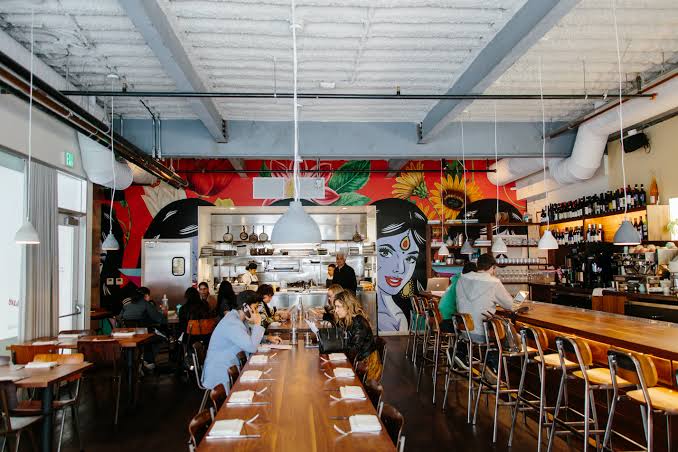
Besharam is located within an arts complex, and its visual identity matches the confidence of its name.
The space has been described as colorful and energetic, with artwork that references South Asian women, popular culture, and unapologetic self-expression.
Restaurant design shapes expectations before a customer tastes anything.
A formal, quiet room creates one kind of experience. Bright colors, close tables, music, and expressive art create another.
Besharam does not present Gujarati food as a fragile object that must be approached with extreme seriousness.
It presents the food within a lively contemporary environment.
This helps communicate that Indian culture is not only historical or traditional.
It is also modern, humorous, political, artistic, and constantly changing.
The restaurant’s design and location within the Minnesota Street Project allow food and visual culture to reinforce each other.
Changing Kitchen Culture
Patel has discussed her desire to build a healthier kitchen environment and lead differently from the harsh, hierarchical model commonly associated with professional restaurants.
Restaurant kitchens have often normalized yelling, humiliation, extreme hours, injury, and emotional abuse in the name of discipline.
Those conditions can be especially difficult for women, immigrants, younger workers, and employees with limited financial security.
Changing kitchen culture does not mean removing standards.
Food still needs to be safe, consistent, and prepared on time.
The question is whether fear is necessary to achieve those results.
Patel’s public comments about leadership suggest that Besharam’s identity includes not only what customers eat but also how the work behind the meal is organized. The restaurant has employed first-generation immigrant workers from several backgrounds, demonstrating that an Indian-owned business can also create opportunity across communities.
No outside article can fully verify every employee’s experience.
The larger point is that leadership values should be judged through daily workplace practices, not simply public statements.
Recognition Brought Visibility and Pressure
Besharam and Patel received significant attention from Bay Area and national food publications.
The restaurant was named San Francisco’s Restaurant of the Year by Eater after its relaunch, and Patel later received recognition within the James Beard Awards process.
Awards can transform a small restaurant.
They bring reservations, media attention, tourism, and opportunities for the chef.
They also create pressure.
Customers may arrive expecting a flawless or life-changing meal. Staff may face higher volumes, and the restaurant can become defined by an award rather than its daily work.
Recognition is valuable, particularly for chefs whose regional cuisines have historically received limited attention.
However, awards do not pay every bill or guarantee long-term stability.
A restaurant survives through repeat customers, effective management, employee labor, financial control, and the ability to adapt when conditions change.
Surviving the Restaurant Industry
Restaurants operate on narrow margins.
Food, labor, rent, insurance, utilities, repairs, permits, and delivery expenses can consume a large share of revenue.
San Francisco adds the challenge of high commercial and living costs.
Besharam also had to navigate the pandemic, when restaurants faced closures, changing health rules, reduced capacity, disrupted supply chains, and uncertainty over whether customers would return.
Small independent restaurants were forced to experiment with takeout, outdoor dining, meal kits, changing menus, reduced staffing, and other survival strategies.
The pressure was especially severe in many Asian business districts and neighborhoods. Research using mobility data found substantial reductions and slow recovery for small urban restaurants, with some of the largest effects occurring in majority-Asian neighborhoods.
Besharam’s continued operation in 2026 is therefore meaningful.
Longevity in the restaurant industry should not be taken for granted.
Indian American Entrepreneurship Extends Far Beyond Technology
Indian American business success is often discussed primarily through technology, medicine, finance, and venture capital.
Those industries are important, but they do not represent the full range of Indian American entrepreneurship.
Restaurants, grocery stores, hotels, transportation companies, fashion brands, educational services, manufacturers, arts organizations, and consumer-product companies also shape the community’s economic presence.
Besharam demonstrates the importance of creative and cultural businesses.
The restaurant creates economic value while also influencing how customers understand Indian identity.
That cultural role can be difficult to measure.
A meal does not only generate revenue.
It can challenge assumptions, support employees, introduce regional history, and make an immigrant woman’s perspective visible in a major American city.
Nationally, Asian American and Pacific Islander entrepreneurs own more than three million firms and employ millions of workers, according to the U.S. Small Business Administration’s Office of Advocacy.
In California, AANHPI-owned companies represent a particularly substantial share of the business community and employ approximately 1.2 million workers, according to a statewide study using federal and survey data.
Representation Within Indian Cuisine Matters
India is often discussed as though it possesses a single culture.
In reality, it contains many languages, religions, ethnic groups, regions, and food traditions.
Restaurants can help make that internal diversity visible.
A Gujarati restaurant tells a different story from a Punjabi, Bengali, Tamil, Kerala, Goan, Kashmiri, or Hyderabadi restaurant.
Even within those categories, family and local differences remain.
Greater representation does not require ranking one region above another.
It requires allowing more regions to be seen.
Besharam contributes to that process by centering Gujarati food and by presenting it through a woman chef’s personal experience.
That combination matters because women have performed much of the cooking that preserves food traditions, while men have often received greater recognition as professional chefs.
Patel’s ownership helps connect culinary authority with the labor and knowledge of women.
The Difference Between Cultural Confidence and Cultural Purity
A culturally rooted business may face contradictory demands.
Some customers want familiar dishes. Others demand complete novelty.
Members of the diaspora may judge whether food tastes exactly like their family’s version, while customers unfamiliar with the cuisine may expect extensive explanation.
No restaurant can satisfy every definition of authenticity.
Cultural confidence offers a better goal than cultural purity.
A confident restaurant understands its influences, names its perspective, and makes deliberate choices.
It does not pretend that its food represents every household.
It also does not change every feature in pursuit of approval.
Besharam’s name summarizes that position.
Patel cooks from her own experience and accepts that not every diner will recognize or agree with every interpretation.
That willingness is part of creative ownership.
Lessons for Other Minority-Owned Businesses
Besharam offers several useful lessons for entrepreneurs.
The first is that a founder’s specific story can become a competitive advantage.
Patel did not attempt to create a generic Indian restaurant. She built around Gujarati food, immigrant memory, womanhood, and her California experience.
The second lesson is that taking ownership can change creative possibilities.
Moving from chef to co-owner gave Patel greater control, but it also required accepting financial and operational responsibility.
The third lesson is that a business name can communicate a complete philosophy.
Besharam is memorable because it connects branding with the founder’s values.
The fourth lesson is that cultural businesses do not need to remain traditional in appearance.
Contemporary art, local produce, modern service, and regional history can exist together.
Finally, workplace culture matters.
A business cannot claim to celebrate dignity and empowerment while ignoring how employees are treated.
How Customers Can Support Indian-Owned Businesses
Supporting Indian-owned businesses can begin with visiting, purchasing directly, making reservations responsibly, and recommending businesses whose work customers genuinely value.
Customers can also explore the diversity within Indian entrepreneurship.
Indian-owned does not mean one type of restaurant, product, religion, language, or region.
A Gujarati vegetarian restaurant, South Indian home-style kitchen, spice company, technology startup, hotel, clothing brand, and tutoring service may all reflect different Indian American experiences.
Support should continue beyond heritage celebrations.
Small businesses need consistent customers throughout the year.
Customers should also avoid expecting free cultural education with every purchase.
Curiosity is welcome, but owners and employees should not be required to explain an entire country or defend their identity during every interaction.
Respectful support includes listening to how a business describes itself.
Key Takeaways
Besharam is an Indian-owned regional Gujarati restaurant in San Francisco’s Dogpatch district.
Chef Heena Patel co-owns and leads the restaurant.
Besharam opened in 2018 within the Minnesota Street Project, and Patel and her husband later took full ownership.
The word besharam is often translated as shameless. The restaurant reclaims it as a statement of resilience and unapologetic self-expression.
Patel’s cooking draws from her upbringing in Gujarat and Mumbai, her family memories, and her life in California.
The restaurant developed into a vegetarian and plant-forward operation centered on regional Indian flavors and seasonal produce.
Besharam challenges the narrow idea that Indian food in the United States must revolve around a small group of familiar dishes.
The restaurant’s visual design, food, and leadership philosophy present Indian identity as contemporary, diverse, and evolving.
Patel has publicly discussed creating a more respectful kitchen culture and leading without relying on humiliation or fear.
Besharam remains active in San Francisco and currently offers dinner reservations and group bookings.
This spotlight is informational and does not constitute an endorsement, sponsorship, paid promotion, or formal certification claim.
FAQ
What is Besharam?
Besharam is a regional Gujarati restaurant in San Francisco led by chef and co-owner Heena Patel.
Is Besharam Indian-owned?
Yes. The restaurant is co-owned by Indian immigrant chef Heena Patel and her husband, Paresh.
Where is Besharam located?
It is located at 1275 Minnesota Street in San Francisco’s Dogpatch district, inside the Minnesota Street Project.
What does Besharam mean?
Besharam is a Gujarati and Hindi word commonly translated as shameless. The restaurant reclaims the term as an expression of boldness and self-confidence.
What kind of Indian food does Besharam serve?
It focuses on Gujarati and western Indian influences interpreted through Patel’s personal experience and California ingredients.
Is Besharam vegetarian?
Besharam identifies with vegetarian and plant-forward Gujarati cooking. Because menus can change, customers should check the current menu before visiting.
Who is Heena Patel?
Heena Patel is an Indian immigrant chef and entrepreneur who grew up in Gujarat, lived in Mumbai, and later moved to the San Francisco Bay Area.
When did Besharam open?
The restaurant opened in 2018. Patel and her husband took full ownership and relaunched it in 2019.
Is Besharam still open?
Yes. Its official website currently lists dinner hours from Wednesday through Sunday and accepts reservations. Hours can change, so diners should verify them before traveling.
Is this article an endorsement?
No. It is an educational minority-owned business spotlight and does not constitute an endorsement, sponsorship, paid promotion, or certification claim.
Final Thoughts
Besharam is not successful because it offers an uncomplicated version of India.
It is compelling because it refuses to pretend India is uncomplicated.
Heena Patel presents food shaped by Gujarat, Mumbai, immigration, family, womanhood, California produce, and years of personal development.
Those influences do not weaken the restaurant’s identity.
They create it.
The business also represents a form of entrepreneurship that is easy to overlook.
Patel did not follow a perfect timeline from culinary school to restaurant ownership. Her knowledge developed through home cooking, employment, migration, caregiving, and later professional experience.
She entered the restaurant industry with a lifetime of information that traditional résumés may not fully capture.
By reclaiming the word Besharam, Patel created more than a restaurant name.
She created permission to cook boldly, to center a regional cuisine, to lead as an immigrant woman, and to stop apologizing for taking up space.
For customers, Besharam offers a chance to experience one expression of Gujarati and Indian American life.
For entrepreneurs, it offers a broader lesson.
A business can become stronger when its founder stops trying to be everything to everyone and begins speaking clearly from a place only they can occupy.
Related Articles
Minority-Owned Business Spotlight: Diaspora Co. Reimagines the Indian Spice Trade From Oakland
https://www.newtoeducation.com/view-blog/minority-owned-business-spotlight-diaspora-co-reimagines-the-indian-spice-trade-from-oakland-6a4f55649ad6a
Minority-Owned Business Spotlight: Saapaaduu Brings South Indian Homestyle Cooking to San Jose
https://www.newtoeducation.com/view-blog/minority-owned-business-spotlight-saapaaduu-brings-south-indian-homestyle-cooking-to-san-jose-6a4dbb8cb3b95
Sources
Besharam — Contact, Location, and Current Hours
Besharam — Press and Founder Coverage
India Currents — A Rooted Immigrant’s “Besharam” Trek to Success
Eater San Francisco — Besharam Restaurant Review
The Plant-Forward Kitchen — Heena Patel
U.S. Small Business Administration — Asian American and Pacific Islander Ownership Statistics
California AANHPI Business Study — Statewide Business Report




