





Editorial Note
Minority-Owned Business Spotlight is a recurring New To Education series highlighting businesses with publicly documented minority, immigrant, veteran, women, Indigenous, or historically underrepresented founder stories.
This article is intended for educational and informational purposes only. Inclusion does not constitute an endorsement, sponsorship, paid promotion, formal certification claim, or recommendation of any company, product, alcoholic beverage, or service.
New To Education is not affiliated with Umami Mart, its founders, employees, suppliers, publishing partners, or participating producers.
Umami Mart sells alcoholic beverages. Alcohol should only be purchased and consumed by adults who meet the legal drinking-age requirements in their location. Alcohol consumption carries health and safety risks, and some individuals should avoid it completely.
Some businesses begin with inventory, investors, and a storefront.
Umami Mart began as a conversation between two friends living on opposite sides of the world.
Yoko Kumano and Kayoko Akabori were childhood friends from California who started the Umami Mart food blog in 2007. At the time, Kayoko was working in New York City while Yoko was living in Tokyo.
The blog gave them a way to stay connected while writing about food, drinks, restaurants, kitchens, and everyday cultural discoveries.
What began as an online creative project gradually became a retail business.
After both women returned to the San Francisco Bay Area, they began selling Japanese barware through the blog. They opened the first Umami Mart physical store in downtown Oakland on August 3, 2012.
Today, Umami Mart describes itself as an independently owned small business headquartered in Oakland. Its selection includes Japanese barware, kitchenware, glassware, sake, shochu, whisky, beer, matcha, and other carefully chosen products from Japan.
The company also organizes tastings, educational programs, memberships, and community events that help customers understand how products are made and used.
Umami Mart demonstrates how a Japanese American-owned business can translate cultural knowledge into retail without reducing Japanese culture to decoration or novelty.
From Childhood Friendship to an International Food Blog
Before Umami Mart became a store, it was a blog.
Kayoko and Yoko grew up together in Cupertino, California, but their professional lives eventually took them to different countries.
Kayoko began writing from New York, while Yoko contributed from Tokyo.
The distance became part of the project’s identity.
One founder could write about food and drinking culture in Japan while the other explored restaurants, products, and urban life in the United States.
The blog was not limited to formal restaurant reviews or polished recipes. Its contributors wrote about everyday experiences, kitchen tools, cocktails, cultural differences, and the social meaning surrounding food.
That approach helped Umami Mart develop a distinctive voice.
It treated Japanese food and drinks as living parts of contemporary culture rather than distant traditions that could only be explained by experts.
The founders were learning, questioning, and sharing alongside their readers.
Their story also shows how a small digital project can develop into a business without beginning as one.
The blog created an audience. The audience developed trust in the founders’ taste. That trust later made it possible to sell products that reflected the same perspective.
The Move From Media to Retail
After returning to the Bay Area, the founders began selling Japanese barware online.
The products fit naturally with the blog’s existing focus on food and drinks.
Readers who had followed their writing could now purchase the glasses, tools, serving pieces, and kitchen items that appeared in the stories.
As demand grew, the founders considered opening a physical space.
The first Oakland store opened in 2012 through a downtown pop-up initiative involving the city and a property owner. According to an interview with the founders, the arrangement allowed them to use a storefront without rent for an initial six-month period before deciding whether to sign a lease.
That opportunity reduced some of the risk attached to opening a new retail business.
Even with the support, the founders did not have enough money to fill the large store with inventory. They had to use creativity, design, and careful product placement to make the space work.
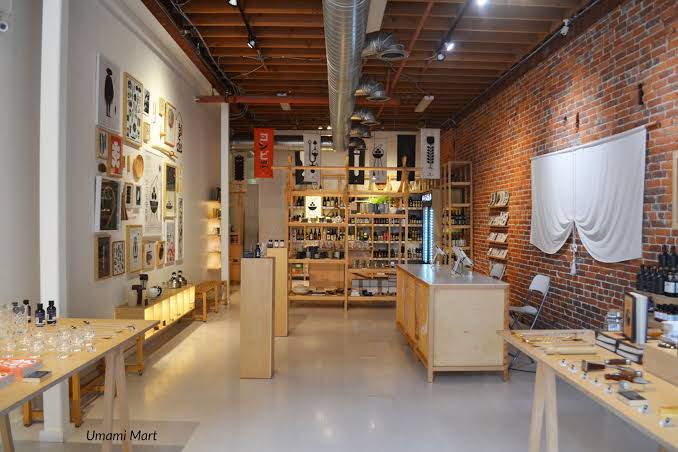
The founders later recalled that customers sometimes entered and wondered whether they were visiting a shop, museum, or gallery.
That reaction reflected an important part of Umami Mart’s model.
The store was not designed as a crowded souvenir shop. It presented ordinary tools and drinking vessels as objects worthy of attention.
Why Oakland Was an Important Home
Umami Mart could have attempted to build its identity in San Francisco, Los Angeles, or New York.
Instead, it developed in Oakland.
Oakland has a long history of independent businesses, immigrant communities, artists, neighborhood institutions, and culturally specific food enterprises.
It also has strong connections to Japanese American and broader Asian American communities throughout the Bay Area.
For Umami Mart, Oakland offered room to create something that did not fit neatly into an existing category.
The store could function as a retailer, bottle shop, educational space, cultural gathering place, and continuation of the original blog.
Its presence also contributes to a broader understanding of Oakland entrepreneurship.
The city’s independent-business identity is not connected to only one community. It has been shaped by Black, Latino, Asian American, immigrant, Indigenous, and other entrepreneurs who built businesses around culture, food, art, and community needs.
Umami Mart’s Oakland identity is therefore not incidental.
The city gave the founders a place to combine Japanese products with a distinctly Bay Area approach to design, education, and community.
A Store Built Around Careful Selection
Umami Mart does not attempt to carry every Japanese product available.
Its business depends on curation.
The founders travel to Japan to explore products, meet makers, and look for items that fit the shop’s standards and identity.
Its selection may include sake glasses, cocktail tools, ceramic cups, strainers, kitchen utensils, tea equipment, serving pieces, and bottles from Japanese producers.
A curated retail model asks customers to trust the owners’ judgment.
Rather than sorting through thousands of similar products on a large online marketplace, customers encounter a smaller collection chosen by people who understand how the items are intended to function.
This does not mean every customer will share the founders’ taste.
It means the store offers a clear point of view.
That perspective is one reason independent retailers can remain valuable even when almost anything can be ordered online.
A large marketplace provides abundance.
A smaller shop can provide context.
Japanese Barware Connects Design With Daily Ritual
A drinking glass may appear simple, but its shape, weight, thickness, texture, and size can affect how a drink is prepared and experienced.
Japanese barware often reflects close attention to small details.
A mixing glass must remain stable while a drink is stirred. A strainer should fit comfortably and control ice. A sake cup can influence temperature, aroma, portion size, and the pace of drinking.
Umami Mart introduces these products through a practical rather than purely decorative approach.
The store’s identity emphasizes that well-designed objects should be used.
A beautiful glass does not need to remain untouched in a cabinet. Its value may come from becoming part of a regular meal, gathering, or quiet evening.
This philosophy helps customers engage with Japanese design through ordinary life.
Culture is not only preserved in museums or ceremonies.
It can also be carried through the objects people touch every day.
Helping American Customers Understand Sake
Sake is widely recognized in the United States, but it is often misunderstood.
Some consumers think of it as a single category with little variation. Others assume it must always be served hot or consumed only with sushi.
In reality, sake can vary according to rice, water, yeast, brewing method, polishing, filtration, pasteurization, aging, temperature, and regional traditions.
Umami Mart has helped introduce customers to that diversity through retail, writing, tastings, events, and its Sake Gumi membership program.
A 2025 profile reported that Sake Gumi had approximately 200 members and was helping establish a local sake culture in Oakland.
Education is commercially useful because unfamiliarity can prevent customers from purchasing a product.
A person may be interested in sake but feel intimidated by labels, terminology, or fear of choosing incorrectly.
A knowledgeable retailer can reduce that barrier.
The most responsible form of alcohol education should also emphasize moderation, health risks, legal age requirements, and the fact that choosing not to drink is completely valid.
Cultural interest should never become pressure to consume alcohol.
Shochu Deserves Its Own Identity
Umami Mart also specializes in shochu, a Japanese distilled beverage that remains less familiar to many American consumers than sake or whisky.
Shochu may be produced from ingredients including barley, sweet potato, rice, brown sugar, or buckwheat.
The ingredient and production method can create substantial differences in aroma and flavor.
Shochu is sometimes confused with Korean soju because the names sound similar in English, but the categories have different histories, ingredients, production methods, and drinking traditions.
An independent specialty retailer can help explain those distinctions without presenting one tradition as more authentic or valuable than another.
Umami Mart’s attention to shochu shows how minority-owned businesses can create markets through education.
The company is not merely responding to existing mainstream demand.
It is helping customers understand why a category deserves attention in the first place.
Japanese Whisky and the Risks of Rapid Popularity
Japanese whisky has developed a strong international reputation.
That popularity has created opportunity for retailers, producers, collectors, restaurants, and bars.
It has also created problems involving limited supply, rising prices, unclear labeling, and products that may use Japanese branding without being fully distilled or aged in Japan.
Specialty retailers have a responsibility to help customers understand what they are buying.
Clear information concerning origin, producer, ingredients, production, and price can reduce confusion.
The wider lesson applies beyond alcohol.
When a culturally connected product becomes globally fashionable, demand can grow faster than public understanding.
Large companies may begin using the culture’s visual identity while offering little connection to its communities or traditions.
Minority-owned retailers can provide a valuable counterweight by centering knowledge, transparency, and relationships with producers.
A Business Can Educate Without Becoming a Museum
One of Umami Mart’s strengths is that it presents cultural information without treating Japan as a place frozen in history.
Its products reflect tradition, but they also reflect contemporary design, changing tastes, and modern everyday life.
This is important because cultural businesses are often expected to choose between authenticity and innovation.
That is a false choice.
Japanese makers continue developing new materials, shapes, drinks, tools, and approaches. Japanese American entrepreneurs also reinterpret those products through their own experiences in the United States.
Umami Mart operates within that movement.
It does not recreate a Japanese shop exactly as it would exist in Tokyo.
It creates an Oakland business informed by Japanese and Japanese American culture.
That distinction allows the company to remain culturally grounded without pretending that culture never changes.
The Founders’ Japanese American Perspective Matters
Umami Mart’s founders grew up in California and built lives connected to both the United States and Japan.
Their perspective helps the business communicate across cultural contexts.
They can recognize which products may require explanation for American customers while also avoiding the tendency to treat every Japanese object as exotic.
This position is common in diaspora entrepreneurship.
People living between cultures often become translators—not only of language, but of use, meaning, social expectations, and taste.
That role can create commercial opportunity.
It can also create pressure.
Customers may expect founders to explain an entire country or speak for every Japanese person.
No business can do that.
Japanese culture contains regional, generational, professional, and personal differences. Japanese Americans also have distinct histories shaped by immigration, exclusion, wartime incarceration, resettlement, intermarriage, and life in the United States.
Umami Mart should therefore be understood as offering its founders’ informed perspective—not the only possible definition of Japanese culture.
Women’s Entrepreneurship Is Central to the Story
Umami Mart was co-founded and developed by two women.
Their story adds to the wider history of women building businesses from skills and communities that traditional investors may initially overlook.
Food writing, product curation, hospitality, cultural interpretation, and community building can be dismissed as interests rather than business capabilities.
Umami Mart turned those abilities into a recognizable company.
The founders had to learn inventory, licensing, leases, importing, marketing, event organization, staffing, and financial management.
That transition is common in small-business entrepreneurship.
A founder may begin because they care deeply about a subject, but survival requires learning every system surrounding it.
The business’s continued operation since 2012 suggests that cultural credibility must be supported by practical discipline.
Passion can start a company.
Operations keep the doors open.
The Blog Remains Part of the Business’s Identity
Many companies launch blogs after establishing themselves because content can improve marketing and search visibility.
Umami Mart developed in the opposite direction.
The content came first.
That history influences the way the company communicates.
Articles, interviews, producer profiles, product explanations, and cultural observations are not simply promotional additions. They are part of the original foundation of the brand.
Content also allows the company to serve people who may never visit the Oakland store or purchase a product.
A reader can learn about Japanese drinks, makers, tools, and cultural practices through the company’s writing.
This creates a broader form of value.
The business makes revenue through retail, but its influence also comes from being a trusted source of information.
For other small businesses, the lesson is not that everyone must become a publisher.
It is that useful content can build trust long before a customer is ready to purchase.
Community Events Turn Retail Into Participation
Physical retail must offer something that a website cannot easily reproduce.
For Umami Mart, events and tastings create that difference.
Customers can speak with knowledgeable people, compare products, meet producers, ask questions, and connect with other members of the local community.
Events also create a reason to return.
A customer may originally visit to purchase a glass or kitchen tool but later participate in a tasting, membership, book event, or educational discussion.
This changes the relationship between the business and customer.
The store becomes a place of participation rather than only a point of sale.
Community programming can be expensive and labor-intensive. Staff must organize schedules, prepare spaces, manage safety, and communicate clearly.
However, it can also create loyalty that is difficult for a large anonymous retailer to match.
Publishing “Everyday Sake” Extends the Educational Mission
Yoko Kumano and Kayoko Akabori expanded their educational work through the book Everyday Sake.
Penguin Random House describes it as an illustrated guide from Umami Mart’s founders intended to help readers understand and enjoy sake.
The book represents another stage in the business’s development.
The founders moved from blog posts to retail, events, memberships, and a published guide.
This shows how expertise created inside a small business can become intellectual property of its own.
A retailer does not only sell products.
It may develop knowledge, teaching methods, stories, terminology, and relationships that can support books, courses, consulting, media, or other services.
For Umami Mart, publishing also reinforces the idea that sake does not need to be reserved for experts or formal occasions.
It can be understood as part of food, friendship, and everyday life—provided it is consumed legally and responsibly.
Independent Importing Requires Strong Relationships
Selling products from Japan involves more than choosing attractive items.
The business must communicate with makers, manage shipping, handle customs requirements, track inventory, absorb currency changes, and respond when supply chains are disrupted.
Small producers may not manufacture in quantities large enough for major retailers.
That can make their work a good fit for a curated shop, but it may also create inconsistent availability.
Independent businesses must explain to customers why an item is temporarily unavailable or why a handmade product costs more than a mass-produced alternative.
These challenges make supplier relationships especially important.
A retailer with direct knowledge of producers can tell customers who made an item, how it is used, and why it was selected.
That information gives the product value beyond its physical function.
Cultural Retail Faces the Risk of Commodification
Any company selling culturally connected products must consider the difference between appreciation and commodification.
Cultural appreciation involves learning, context, respect, and recognition of the people behind a practice or object.
Commodification occurs when symbols are separated from their meaning and sold mainly because they appear fashionable or exotic.
Umami Mart’s educational model helps reduce that risk by explaining products and introducing makers.
Still, no retail transaction can carry the full history of a culture.
Customers share responsibility.
They can approach products with curiosity, avoid turning traditions into costumes, and understand that buying an item does not make someone an expert.
A culturally rooted business can open a door.
Respectful learning requires the customer to continue through it.
Why Independently Owned Specialty Shops Matter
Large retailers can often offer lower prices, faster shipping, and broader inventory.
Independent shops compete differently.
They can provide expertise, relationships, product testing, local events, and a clear sense of identity.
They may also support smaller producers whose work would disappear inside a major marketplace.
Umami Mart’s value comes partly from helping customers decide among products they may not fully understand.
The store reduces uncertainty through selection and education.
That role becomes particularly important when a product is connected to another language or cultural system.
Search engines can provide information, but they often produce contradictory or shallow answers.
A knowledgeable specialty retailer can connect the product with lived experience.
Lessons for Other Minority-Owned Businesses
Umami Mart’s development offers several lessons.
The first is that a creative project can become a business gradually.
The founders did not need to begin with a fully developed retail plan. They built an audience and identity before opening the store.
The second lesson is that expertise can be developed publicly.
The blog allowed the founders to share what they were learning rather than waiting until they could claim complete authority.
The third is that curation can compete with scale.
A small company does not need to carry everything. It can build trust by choosing carefully and explaining those choices.
The fourth lesson is that a physical store should provide experiences that online shopping cannot replace.
Events, tastings, memberships, and personal guidance help create community around the products.
Finally, cultural identity can support innovation.
Umami Mart does not succeed by copying an existing Japanese retailer. It combines Japanese products, Japanese American experience, Oakland culture, and modern independent retail.
How Customers Can Support Japanese American-Owned Businesses
Customers can support Japanese American businesses by purchasing directly, attending events, recommending them, and learning the specific history behind each company.
Support should extend beyond moments when Japanese culture becomes fashionable.
Small businesses need consistent customers throughout the year.
Consumers should also avoid assuming that every Japanese-themed business is Japanese American-owned.
A restaurant, clothing label, or retail store may use Japanese language and design without having Japanese or Japanese American ownership.
Ownership does not automatically determine quality, but it affects where economic value goes and whose perspective shapes the business.
Customers seeking culturally connected products can ask who founded the company, who currently owns it, and how it works with makers and communities.
Key Takeaways
Umami Mart is an independently owned Japanese American business headquartered in Oakland, California.
Childhood friends Yoko Kumano and Kayoko Akabori began Umami Mart as a food and drink blog in 2007.
At the time, Kayoko was working in New York City and Yoko was living in Tokyo.
After returning to the Bay Area, they began selling Japanese barware through the blog.
The first physical Umami Mart store opened in downtown Oakland on August 3, 2012.
The company sells Japanese barware, kitchenware, glassware, sake, shochu, whisky, beer, matcha, and related products.
Its business model combines retail with writing, tastings, memberships, events, and cultural education.
The founders travel to Japan to explore products and develop relationships with makers.
Umami Mart helps American customers understand Japanese drinks and design without treating them merely as exotic novelties.
The company’s development shows how content, curation, cultural knowledge, and community can support an independent retail business.
This article is informational and does not constitute an endorsement, sponsorship, or alcohol recommendation.
FAQ
What is Umami Mart?
Umami Mart is an independently owned Oakland business specializing in Japanese barware, kitchenware, sake, shochu, whisky, beer, matcha, and cultural education.
Who founded Umami Mart?
It was founded by Japanese American childhood friends Yoko Kumano and Kayoko Akabori.
When did Umami Mart begin?
It began as a food and drink blog in 2007. Its physical Oakland store opened in 2012.
Is Umami Mart Japanese American-owned?
The company was founded and continues to be operated by Japanese American entrepreneurs Yoko Kumano and Kayoko Akabori.
Where is Umami Mart located?
The company is headquartered in Oakland, California. Customers should check its official website for the current retail address, operating hours, and event schedule.
What does Umami Mart sell?
Its selection includes Japanese bar tools, glassware, kitchen tools, ceramics, sake, shochu, whisky, beer, matcha, and other products from Japan.
What is Sake Gumi?
Sake Gumi is Umami Mart’s sake membership program, designed to introduce members to selected bottles and provide additional education about producers and styles.
What is shochu?
Shochu is a Japanese distilled beverage that may be made from ingredients such as barley, sweet potato, rice, brown sugar, or buckwheat.
Do customers need to drink alcohol to appreciate Umami Mart?
No. The business also sells kitchenware, barware, glassware, tea products, and other nonalcoholic items. Cultural learning should never require alcohol consumption.
Did the founders write a book?
Yes. Yoko Kumano and Kayoko Akabori are the authors of Everyday Sake, an illustrated guide to understanding and enjoying sake.
Is this article an endorsement?
No. It is an educational minority-owned business spotlight and does not constitute an endorsement, paid promotion, sponsorship, certification claim, or recommendation to consume alcohol.
Final Thoughts
Umami Mart began before its founders knew it would become a store.
That may be one of the most valuable parts of its story.
Yoko Kumano and Kayoko Akabori began by writing, sharing, learning, and maintaining a friendship across continents.
The business grew because readers trusted the perspective behind the blog.
When the founders began selling products, they were not introducing an unrelated commercial venture. They were giving physical form to the interests and community they had already created.
Umami Mart’s success also shows how Japanese American entrepreneurship can connect heritage with contemporary life.
The company does not present Japanese culture as something distant, fragile, or frozen.
It places Japanese glasses, kitchen tools, drinks, and design within everyday Oakland life.
Customers are invited to use the objects, ask questions, meet other people, and develop their own understanding.
That approach turns retail into cultural participation.
Umami Mart may sell objects and bottles, but its deeper product is context.
In a marketplace filled with endless choices, context may be one of the most valuable things an independent business can provide.
Related Articles
Minority-Owned Business Spotlight: Bachan’s Brings a Japanese Family Sauce From Sonoma County to Kitchens Across America
https://www.newtoeducation.com/view-blog/minority-owned-business-spotlight-bachans-brings-a-japanese-family-sauce-from-sonoma-county-to-kitchens-across-america-6a4f4532b3532
Minority-Owned Business Spotlight: Fugetsu-Do Confectionery
https://www.newtoeducation.com/view-blog/minority-owned-business-spotlight-fugetsu-do-confectionery-6a4cd7ea8d9ea
Sources
Imbibe Magazine — How It Started: Umami Mart
SCORE — Umami Mart Success Story
Sake World — How Umami Mart Proposes Enjoying Sake the American Way




